
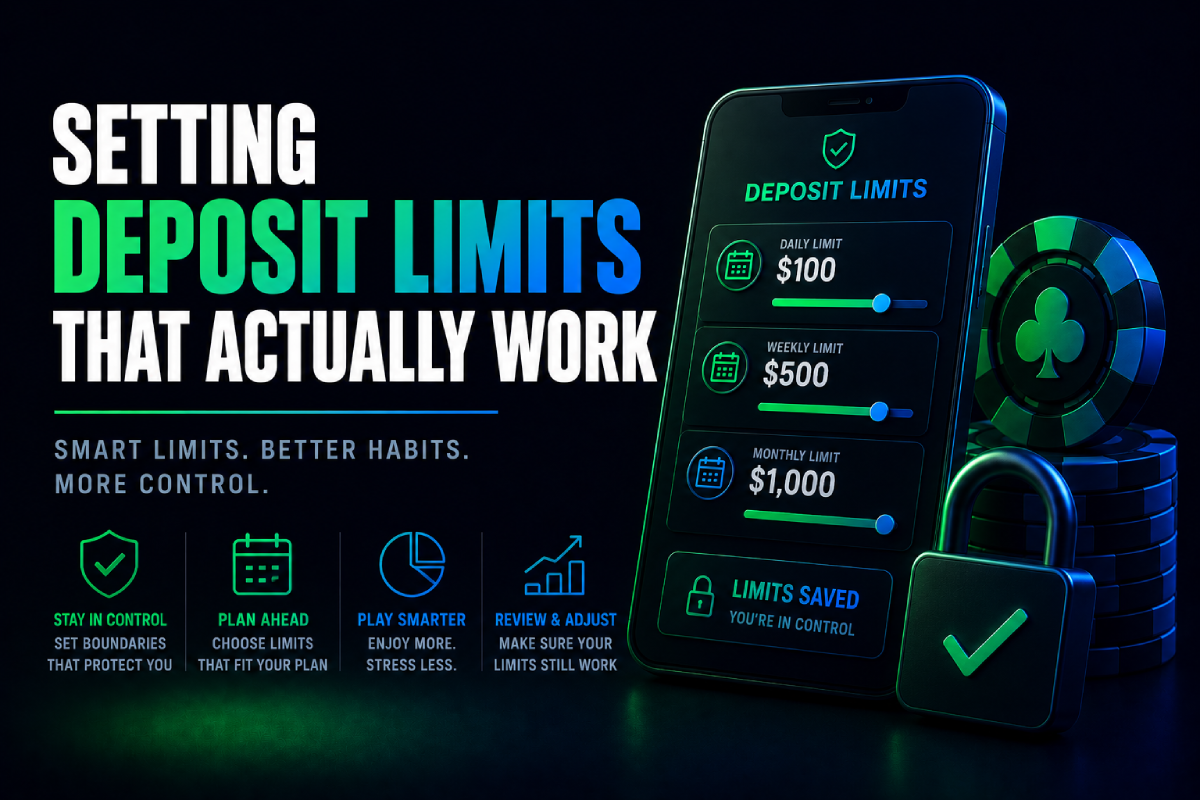
A deposit limit is the closest thing online gambling has to a seat belt. It only works if you set it before you need it, and it only helps if the number you pick matches how you actually play, not the amount you think would sound sensible to a stranger. The point of a limit is friction at the right moment, and friction only appears if the number is meaningful.
Most licensed casinos in 2026 now prompt you to set a monthly deposit limit before your first deposit. That is a real improvement. What the prompt cannot do for you is choose a number that matches your life. This guide is how we think about it.
Why a limit is worth setting
A limit is a promise you make to yourself when you are calm, that will hold when you are not. Most in-the-moment spending decisions are made in a very different mood from the one that wrote the limit. If the limit is realistic, it will only bite when you are stepping out of your normal pattern. That is exactly the point.
Picking a real number
The number that works is the amount you would be comfortable losing in a full month with no wins to offset it. Not the amount you plan to play, not the amount you think you’ll win from. The one you would lose. If that number is hard to write down, that is a signal, not a sign that the exercise is broken.
| Bad limit-setting | Better limit-setting |
|---|---|
| The amount I plan to play | The amount I would be fine losing |
| What I lost last month | What I could afford to lose next month if the worst happens |
| Round numbers “because they look nice” | A number you would say aloud to someone who knows you |
| Deposit limit but no time-in-session limit | Both, tied together |
Daily vs weekly vs monthly
The monthly limit is the anchor. It should match the amount you can afford to lose. On top of that, a daily limit is a very effective brake on a bad session, because most impulsive spending happens in an hour, not across a month. Weekly is a middle ground that suits players with an irregular schedule. Set the monthly first, then decide whether the daily makes sense for how you actually play.
Adjusting the limit
Every licensed operator makes lowering a limit instant and raising a limit slow. That is on purpose. Do not try to fight it. If you feel the urge to raise the limit inside a session, that is the exact moment the limit is doing its job. Save the change for a calm week and revisit it then.
If the limit isn’t enough
A limit is a support, not a cure. If you are asking yourself whether you should be gambling at all, please reach out to a service that is set up to help: GamCare in the UK, Spelberoendes Riksförbund in Sweden, Kansspelautoriteit’s helpline in the Netherlands, or your local equivalent. Our responsible-gambling page has a short list.
How this fits our reviews
Everything here reflects the way CasinoClaude tests casinos: real deposits, timed cash-outs and terms read to the last line. If you want to see the method applied to specific sites, pick a country from the top menu.
FAQ
Can I lower my limit at any time?
Yes. Every licensed operator honours a lower limit immediately. Raising it is deliberately slow and always includes a cool-off.
Does a self-imposed limit work across multiple casinos?
Not by default. Some markets, like the UK with GAMSTOP, offer a cross-operator self-exclusion. Deposit limits are typically per-site, which is a reason to run them everywhere you play.
Do I have to give a reason when I set a limit?
No. Operators cannot ask why. The number is enough on its own.
