
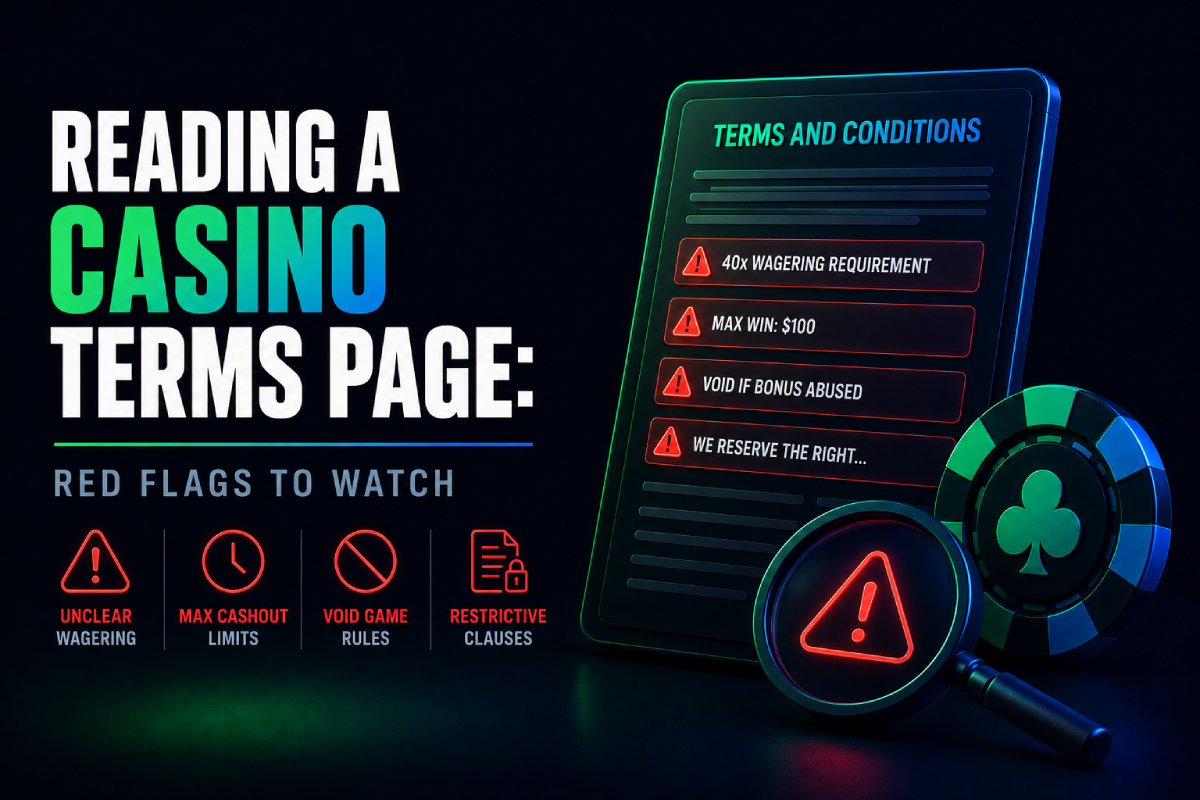
Nobody wants to read a terms page. Casino operators know it, which is why the terms page has quietly become the honest description of who they are behind the marketing. The good news is that you don’t have to read all of it, you just need to know which five sections are worth your time and what the red flags look like when they turn up.
The five sections below decide, in almost every case, whether a casino is safe to play at and whether cashing out will be a fight. Ten minutes with them before your first deposit is the highest-return use of your time on any casino site.
1. Withdrawal rules
Look for the daily, weekly and monthly cash-out limits and for anything that lets the casino pay out a big win as an instalment schedule. A licensed operator will usually pay any verified balance inside a reasonable window; some large lifetime wins get spread across weeks or months, and the terms should tell you exactly how. If they don’t, or if the monthly cap is small enough that a lucky night would take a year to withdraw, keep walking.
2. Dormant account clauses
Every casino has a policy for accounts that stop being active, and the honest ones start charging a small monthly fee, or transfer the balance somewhere neutral, only after a long idle window. The dishonest version writes off any balance after three months of inactivity and keeps the money. Look for the trigger period and the amount, and treat “we reserve the right” language as a signal to close and take your balance out before you forget.
3. Bonus abuse language
“Bonus abuse” is a legitimate concept operators use to stop a small number of professional exploiters from breaking promos. It is also, in a small minority of cases, a catch-all excuse to void winnings from ordinary play. Look for language that defines abuse in specific behaviour, low deposits, repeated identical patterns, coordinated accounts, rather than in sole discretion. If the operator reserves the right to declare you an abuser without a defined test, that language will be used against a normal player at some point.
| Phrase | What it usually means |
|---|---|
| “At the sole discretion of the operator” | The operator can decide anything without recourse |
| “Winnings may be forfeited” | They can cancel a bonus balance for a defined breach |
| “Manual review may take up to X days” | Withdrawals above a threshold sit in a queue |
| “Maximum cashout from bonus winnings” | The bonus, no matter how big it grows, can never pay more than a fixed sum |
4. Dispute resolution
A licensed operator will name its regulator and a specific alternative dispute-resolution service. Both should be links you can follow. If the terms only send you to the operator’s own support desk for every complaint and never to a third party, that is a signal the licence is either weak or missing, and it is the single most important thing to check.
5. Governing law and licence
The last serious clause is the one that tells you which law applies and which regulator you can appeal to. Malta, the UK, Sweden, the Netherlands and Denmark are all licences with real teeth. Curaçao is now more meaningful than it used to be but still varies operator by operator. A licence you have never heard of, or an offshore address without a link to the regulator’s public register, is a red flag on its own.
How this fits our reviews
Everything here reflects the way CasinoClaude tests casinos: real deposits, timed cash-outs and terms read to the last line. If you want to see the method applied to specific sites, pick a country from the top menu.
FAQ
How long should reading a terms page take?
For the five sections above, ten minutes on your first visit and a scan on any operator that changes ownership. Skimming the marketing text won’t take longer than that; the point is to open the page at all.
What is the single biggest red flag?
Dispute resolution that doesn’t name a third party. Everything else can be lived with; that one always signals a licence problem.
If a casino has good terms but bad reviews, which wins?
Trust the terms and then trust the specific pattern in the reviews. Old reviews about old ownership don’t predict much. Recent, consistent complaints about slow withdrawals do.
